



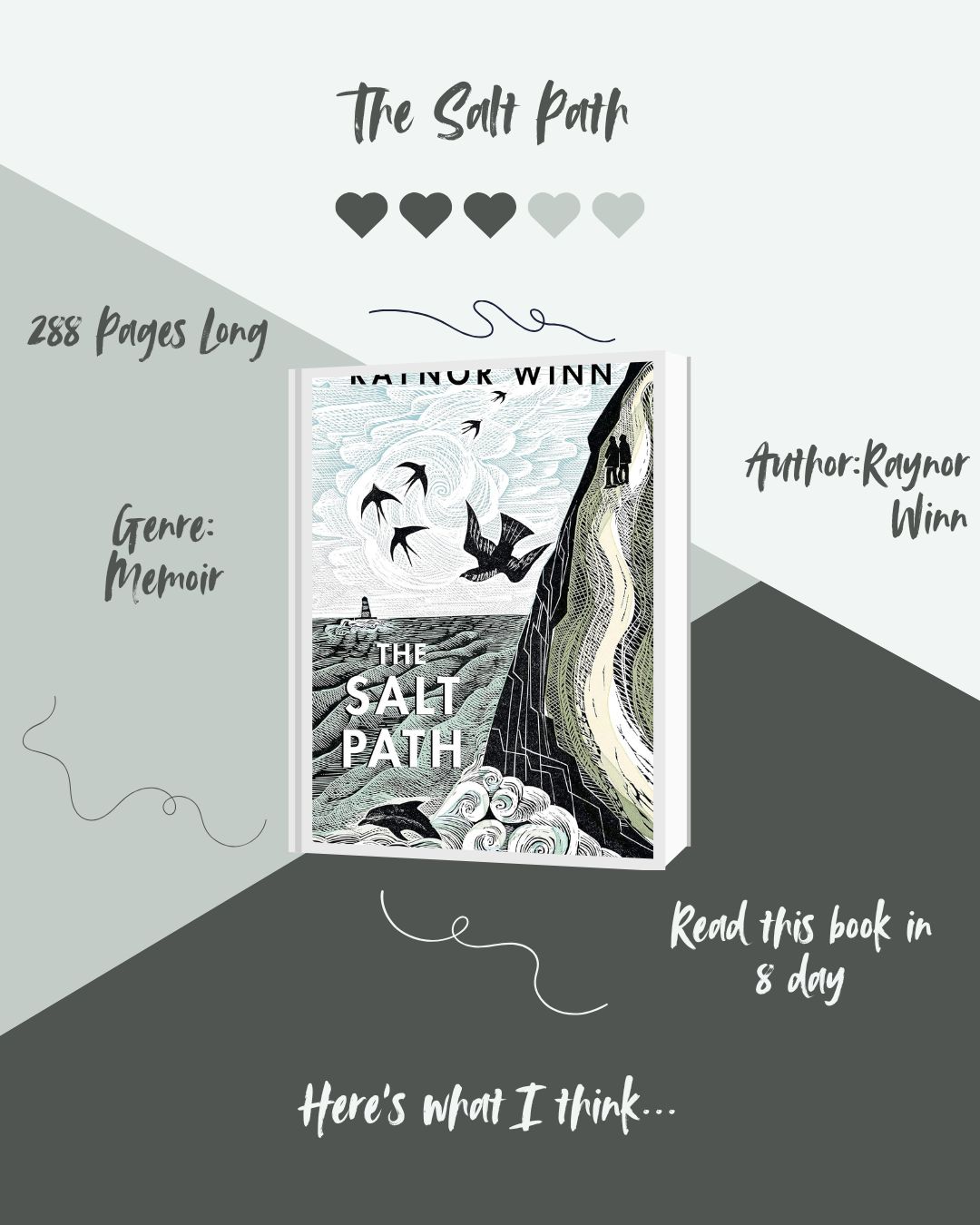

⭐️3/5 stars
📖 Length: 288 pages
📱 Format: Paperback
⏳ Read Time: 8 days
Synopsis
Just days after Raynor learns that Moth, her husband of 32 years, is terminally ill, their home is taken away and they lose their livelihood. With nothing left and little time, they make the brave and impulsive decision to walk the 630 miles of the sea-swept South West Coast Path, from Somerset to Dorset, via Devon and Cornwall.
Carrying only the essentials for survival on their backs, they live wild in the ancient, weathered landscape of cliffs, sea and sky. Yet through every step, every encounter and every test along the way, their walk becomes a remarkable journey.
The Salt Path is an honest and life-affirming true story of coming to terms with grief and the healing power of the natural world. Ultimately, it is a portrayal of home, and how it can be lost, rebuilt and rediscovered in the most unexpected ways.
What I thought
I went into The Salt Path with absolutely no expectations and not because that’s my usual approach to reading (it really isn’t), but because this was one of those slightly random picks. A kill two birds with one stone kind of read. A book to complete a Goodreads Challenge, one that I already had on my shelf and a page count that fit my reading mindset at the time. Short. Palate-cleaner short. That was genuinely the whole decision-making process behind this read.
And for a while, that worked. I settled into what I thought would be an interesting read and whilst the writing is often lovely, there were moments (and not just one or two) where things felt a bit too neat, a bit too cinematic, a bit too everything worked out exactly when it needed to. Random encounters, unlikely kindnesses, miraculous survivals… it started to feel less like a raw memoir and more like a carefully curated version of events. I found myself squinting at the page more than once thinking, “WTF. Surely not? Did that really happen?”
After finishing the book, I became aware of the controversy surrounding it. Questions about how accurate parts of the story really are, whether certain events were presented more dramatically than reality, and whether some key details were, let’s say, selectively framed. Knowing that instantly knocked a star off for me. Memoirs live and die on trust, and once that doubt creeps in, it’s hard to fully settle into what is being sold.
Which is a shame, because without that background noise, this probably would have been a solid 4-star read for me. The writing flows beautifully, the emotional beats mostly land, and I can completely understand why so many readers found it comforting and inspiring. But the lingering uncertainty around the story itself kept pulling me out of it.
So: 3 stars.
It’s OK. It reads well. The coastal walking aesthetic is strong. But the “how much of this is actually true?” feeling stopped it from being something I could really love.
Overall
Overall would I recommend it? Yes, with caveats. Go in for the atmosphere and the emotional journey, not as a rock-solid account of events. And maybe don’t Google it until after you’ve finished… unless you enjoy side-eyeing a memoir as much as I apparently do. 😅
Interested in picking this up? You can get copies below.
On Amazon – here
Bookshop.Org – here
Until next time… 🖤
Leave a Reply